

Case Study · UX / UI

Identifi

A speculative interface built around you — scan your face, explore a 3D avatar of yourself, and see where your image may exist across the internet.

  • UCI Designathon 2025
  • Top 10 / 250
  • Speculative
  • Privacy
Identifi interface — speculative facial scan and 3D avatar exploration

Top 10

Placement

UCI Designathon · 250 teams

48 hr

Timeline

Designathon sprint

4

Team

Kyuhong · Ben · Allie · Emily

2025

Year

Figma · Blender · Illustrator

(Problem)

Every interaction online leaves a trail — images, behaviors, search history, biometrics, identity markers users rarely see or fully understand.

As AI, facial recognition, VR, and neural interfaces integrate into daily life, the data being collected is becoming increasingly intimate.

What if people could actually see where pieces of themselves existed online?

The turning point

A teammate discovered her Instagram photos reposted on inappropriate sites without consent. Removal took weeks of DMCA requests and platform outreach — shifting the project from abstract “digital privacy” into something urgent and personal.

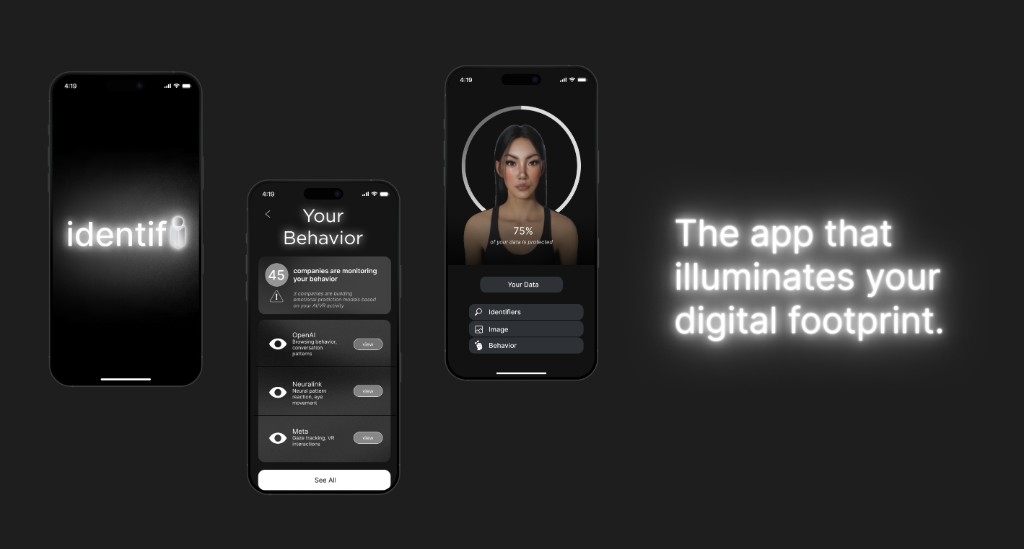
Identifi app screens — the app that illuminates your digital footprint
Invisible data, made visible

(Goal)

The prompt

“Design a speculative interface for future technologies.”

Make invisible data visible — starting with your own face. Privacy as something you can orbit, inspect, and act on — not read in a terms-of-service PDF.

(Solution)

Introducing Identifi

Identifi centers on a speculative facial scan of yourself. The app captures your likeness and builds a 3D avatar you can explore — your data made spatial, personal, and alive. From there, Identifi would speculatively scan the web for matches: where your face, edits, and reuploads surface without your knowledge.

Identity, likeness, and behavioral signals branch out from that core — framed as living data in motion, not spreadsheets or legal text.

Core interaction

Scan → avatar → search. A speculative loop: see yourself rendered in 3D, then watch the app trace where that image travels online.

Identifi onboarding animation — splash, scan, and data map
Onboarding loop · splash → scan → footprint map

(Architecture)

Everything radiates from the scan. Three data pillars organize what Identifi surfaces once your likeness is captured — tap to expand each category.

01 Identifier Identity data
  • Name
  • Email address
  • Phone number
  • Linked accounts
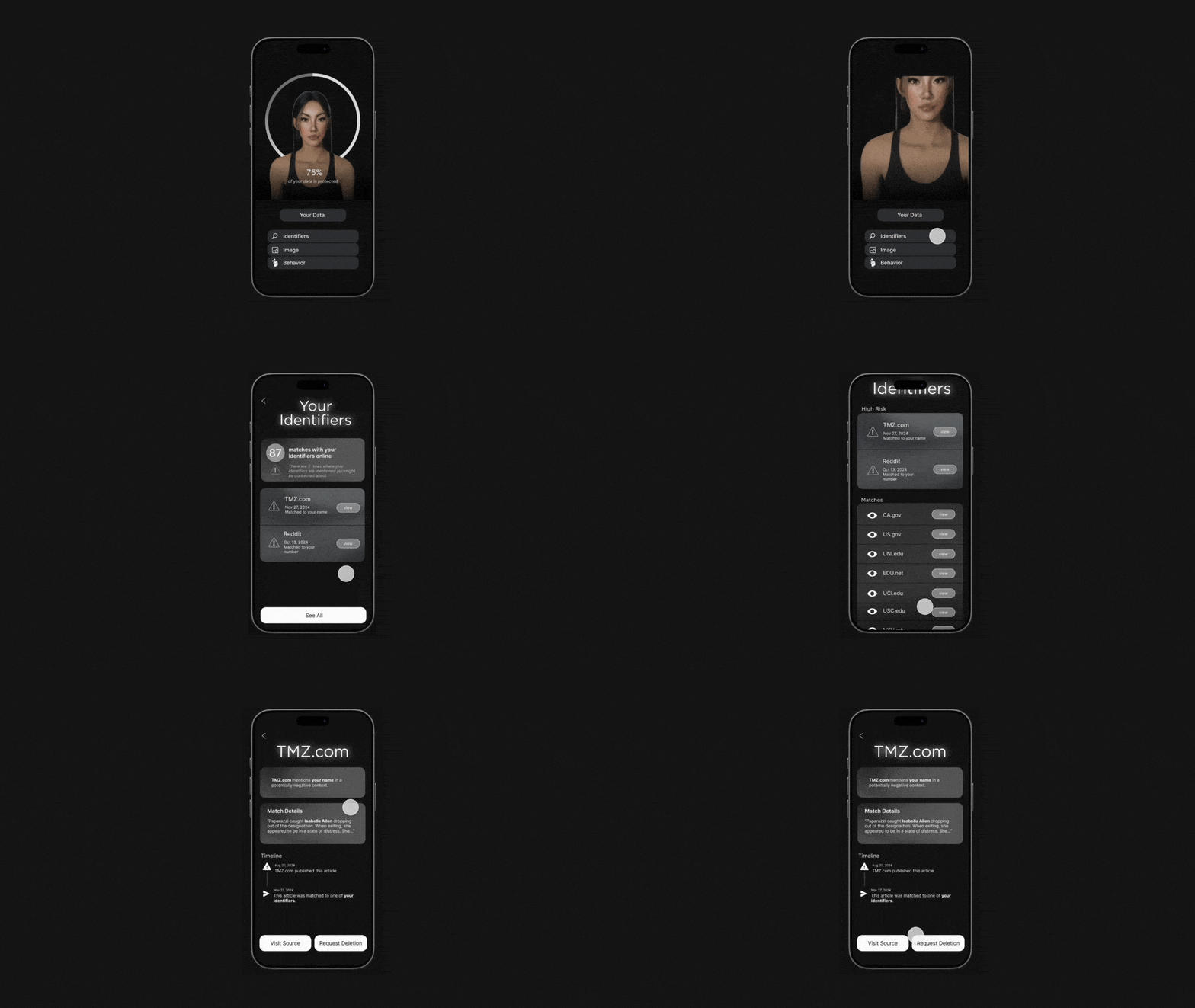
Identifi Identifiers view — avatar and Your Data categories
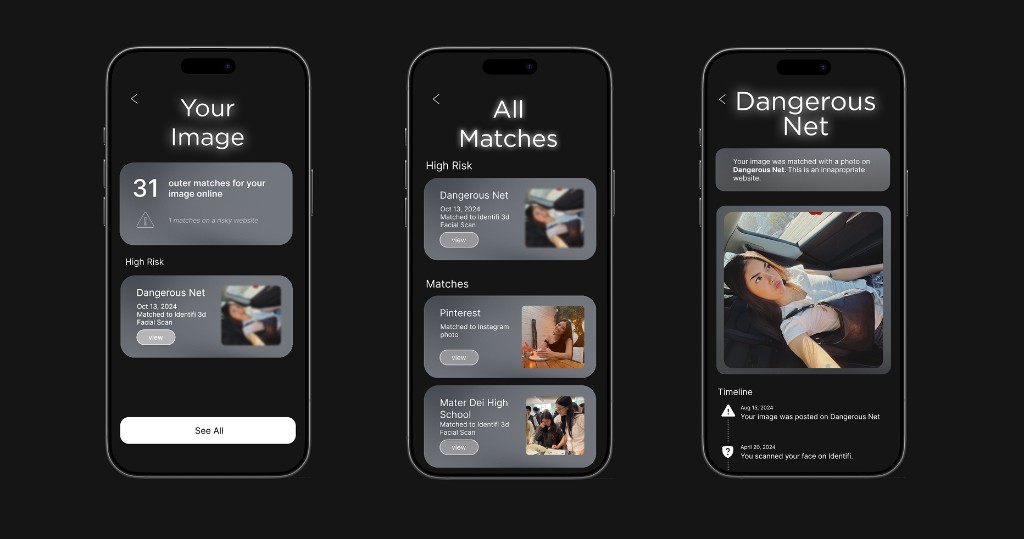
02 Likeness Image data · starts at the scan
  • 3D avatar generated from facial scan
  • Web-wide image & likeness matches
  • Facial recognition hits
  • Edited / reuploaded images
Identifi Your Image screens — matches, risk levels, and detail view
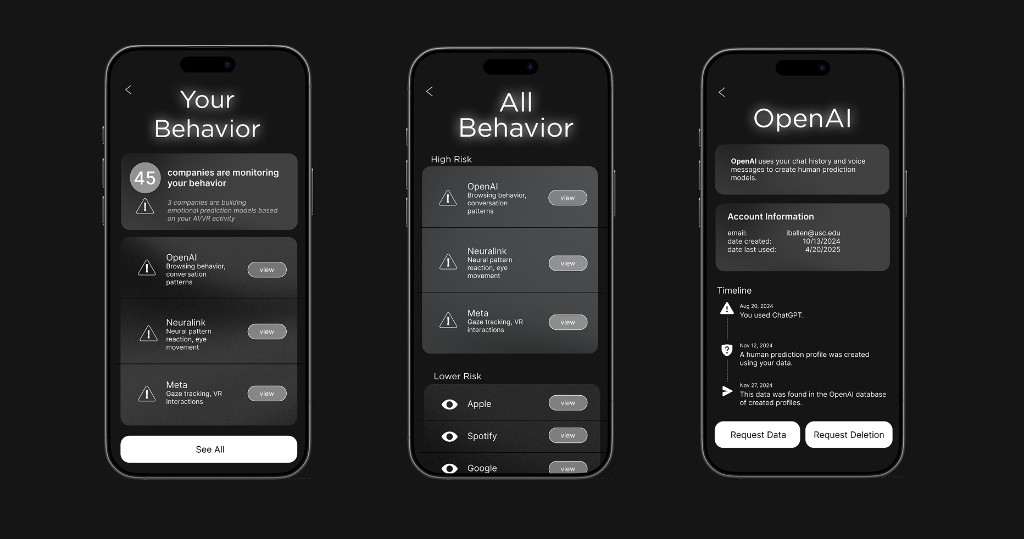
03 Behavioral Behavioral data
  • AI interaction history
  • Algorithmic profiling
  • VR interaction patterns
  • Neural interface data
Identifi Your Behavior screens — company monitoring and data detail

(Process)

Lo-fi

Explorations

Quick sketches to define navigation flow, data hierarchy, emotional pacing, and what users should feel at each stage. Early concepts focused on discovery — uncovering unknown information about yourself online.
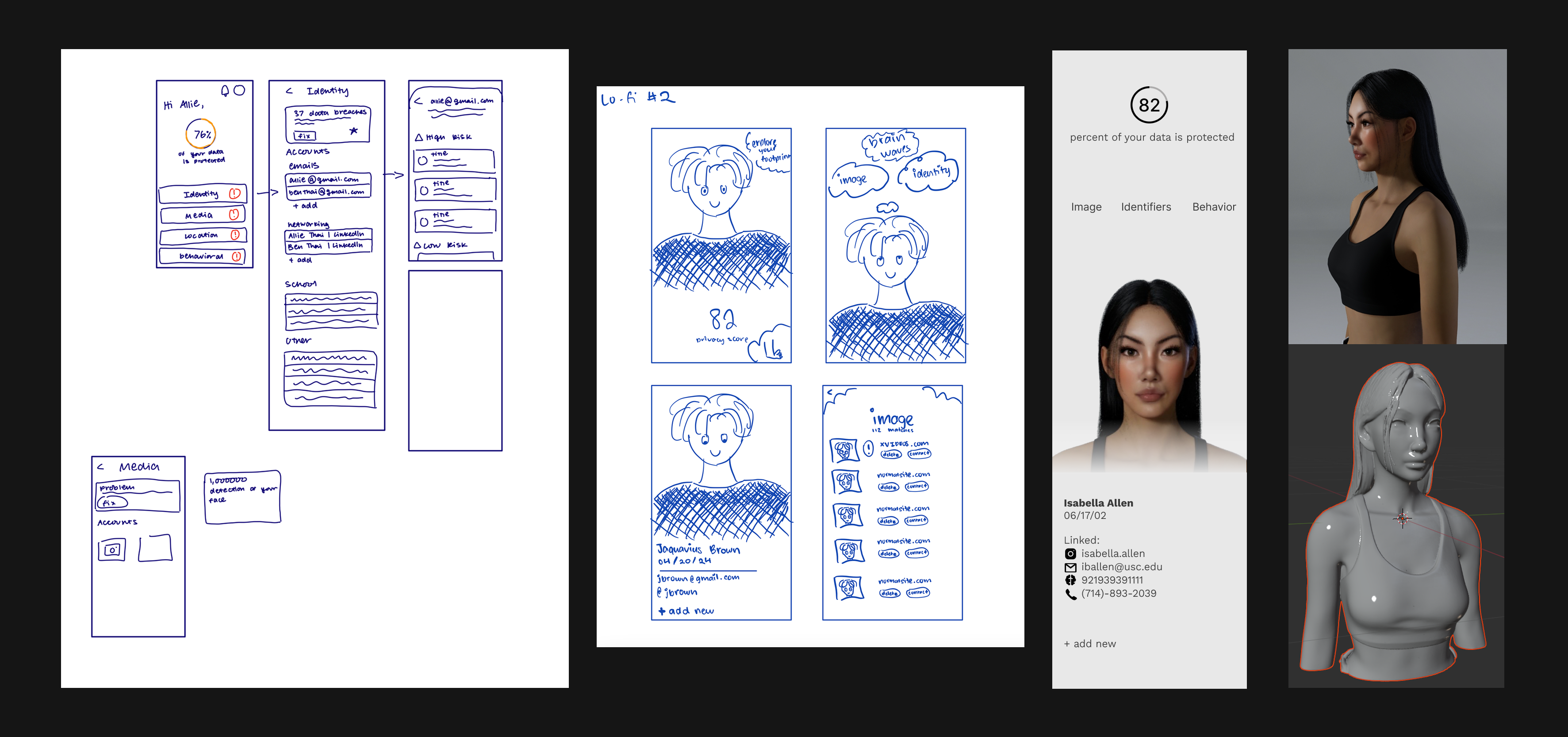
Identifi lo-fi explorations — behavior flow screens
Lo-fi navigation & hierarchy sketches
Hi-fi

Prototype

Full UX flows in Figma — facial scan onboarding, 3D avatar exploration, web image search results, data categorization, threat detection, and deletion workflows. Major focus on making an unsettling process feel navigable.

Hi-fi prototype walkthrough

(Results)

Identifi placed top 10 at UCI Designathon 2025 — not just as a concept deck, but as a navigable speculative product judges could click through, argue about, and remember.

Top 10

of 250 teams

6

core flows shipped

48 hr

concept to prototype

Recognized for

Visual Identity

A distinct speculative world that made abstract data feel visceral

Recognized for

Concept

Framing privacy as personal — tied to your face, not fine print

Recognized for

Innovation

A fresh angle on surveillance literacy and digital ownership